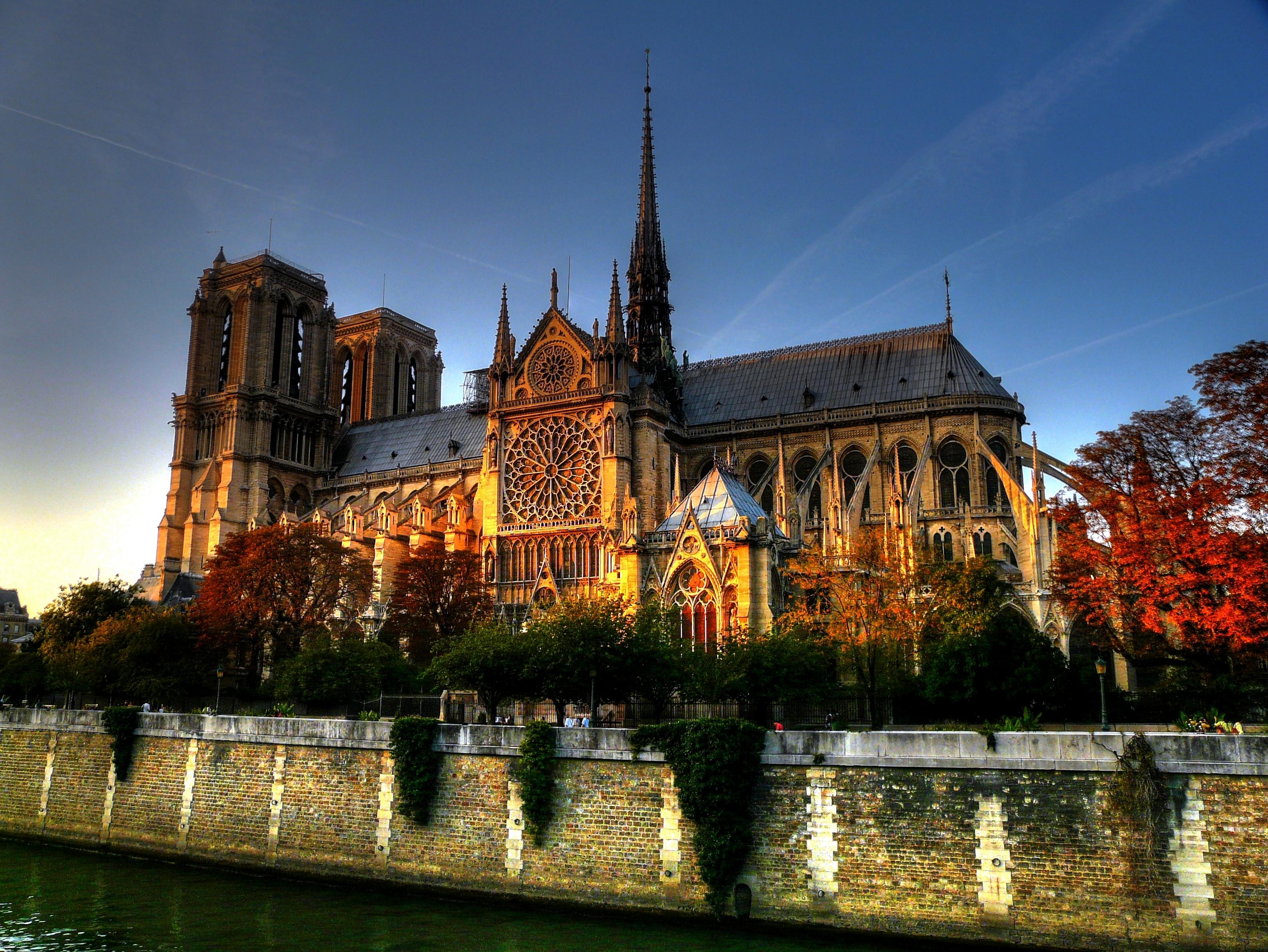
You’ve seen them. The grainy black-and-whites from the 1800s, the oversaturated vacation snaps from the 90s, and those terrifying, orange-tinted shots from April 2019. Cathedral of Notre Dame pictures aren't just photos; they are a visual timeline of a building that refuses to stay the same. If you look at a photo taken in 2010 versus one taken this morning, you’re looking at two different versions of French history. Honestly, the shift is jarring once you know what to look for.
Most people think of Notre Dame as this static, eternal pile of stone. It isn’t. It’s more like a living organism that’s currently in a massive state of regrowth. Since the 2019 fire, the way we document this place has shifted from capturing "the monument" to capturing "the process."
The spire that wasn't always there
Let's clear something up. That iconic spire you see collapsing in all those 2019 videos? It wasn't medieval. Not even close. When you browse through vintage Cathedral of Notre Dame pictures, you might notice that in very early daguerreotypes, the roof looks... flat. That’s because the original medieval spire was actually removed in the late 18th century because it was literally rotting away and becoming a hazard.
The spire everyone mourned was a 19th-century addition by Eugène Viollet-le-Duc. He was a guy who didn't just want to "fix" buildings; he wanted to make them "perfect," even if that meant adding things that weren't there originally. He even tucked statues of the twelve apostles at the base of the spire. Interestingly, in a stroke of absolute luck, those statues were removed for restoration just days before the fire. They survived because they weren't actually on the roof when it went up in flames.
Today, the new spire is a faithful reconstruction of Viollet-le-Duc’s design. If you see a photo where the lead looks exceptionally shiny and silver, that’s a new one. The old lead had a dull, grey patina from decades of Parisian smog and oxidation. This new one will eventually fade, but for now, it pops against the sky like a fresh nickel.
Why your old photos might be toxic (literally)
This is the part nobody likes to talk about. If you have Cathedral of Notre Dame pictures where you're standing on the parvis (the big open square out front) prior to 2019, you were standing on a site that essentially became a lead-dust hazard zone overnight. When the roof and spire burned, over 400 tons of lead melted and dispersed into the air.
It’s why, for a long time after the fire, photos showed these massive, ugly yellow fences and workers in what looked like hazmat suits. The cleanup wasn't just about moving scorched oak beams; it was a massive de-leading operation. Even the interior stone had to be vacuumed with specialized HEPA filters and scrubbed with a "latex film" that peels off the grime.
The Great Cleaning Paradox
Ironically, the fire might have made the cathedral look better than it has in centuries. For hundreds of years, the interior was covered in a thick layer of soot, dust, and candle wax. It was dark. Moody. Kind of dingy, if we’re being honest. But because of the restoration, the interior stone has been cleaned back to its original creamy, blonde Lutetian limestone.
If you see an interior shot where the walls look almost white or golden, that’s a post-restoration photo. If it looks dark and cavernous? That’s the "old" Notre Dame. The difference is like switching from a 480p YouTube video to 4K.
Framing the "Forest"
Photographers used to love shooting the roof from the towers. They called the lattice of ancient oak beams "The Forest" (La Forêt). Every beam was a single tree, most of them cut in the 12th and 13th centuries. Those are gone. Entirely.
The new "Forest" is being built with new oaks, sourced from former royal forests across France. Philippe Villeneuve, the chief architect, insisted on using the same medieval techniques. That means hand-hewn beams. If you look closely at modern construction photos, you’ll see the marks of the axe rather than the clean slice of a circular saw. It’s a tiny detail, but for the purists, it’s everything.
How to spot a "fake" or AI-generated image
Lately, the internet is flooded with "artist renderings" and AI-generated Cathedral of Notre Dame pictures that claim to show the finished interior. Don't get fooled.
- Check the scaffolding: If the photo looks "too perfect" and doesn't have a single pipe or crane, it’s likely a render. The site is still a massive construction zone.
- The windows: The stained glass—specifically the Rose Windows—survived the fire, but they were heavily cleaned. AI often struggles with the specific geometry of the North Rose.
- The surrounding trees: Look at the trees in the square. If they look like lush, generic oaks from a video game, it's a fake. The actual trees around the cathedral are often pruned in the distinct French pollarding style.
The best angles for the "New" Notre Dame
If you’re heading to Paris soon, you can’t just walk in yet. The grand reopening is slated for late 2024 (specifically December 8th), but the exterior is largely visible.
The best spot for Cathedral of Notre Dame pictures right now isn't the front. The front (the West Facade) looks mostly the same because the fire didn't take down the iconic twin towers. The real drama is at the back—the Chevet. From the Quai de la Tournelle on the Left Bank, you get a clear view of the new spire and the flying buttresses.
Another pro tip: go to the Pont de la Tournelle at sunset. The light hits the new lead on the spire and makes it glow. It’s the kind of shot that makes people ask if you used a filter, but it’s just the raw physics of new metal and Parisian "blue hour."
What most people miss in their photos
Look at the gargoyles. Or, more accurately, the chimeras. Most people zoom in on the "Stryge"—that famous horned demon resting its head on its hands. Here’s a fun fact to impress your friends: that guy didn't exist until the 1840s. He’s a "fake" medieval monster added during the 19th-century restoration.
When you take your photos, look for the water spouts. The actual gargoyles are the ones designed to kick water away from the stone walls. The ones that just sit there looking cool? Those are chimeras. In post-fire photos, you might see that some look cleaner than others. That’s because several were replaced or heavily repaired after being scorched or hit by falling debris.
The Actionable Insight: Documenting History
If you have old photos of the cathedral, keep them. Don't delete the blurry ones. They are now historical records of a version of the building that technically no longer exists.
To get the best results for your own collection today:
- Skip the midday sun: The limestone reflects a lot of light. You'll end up with "blown-out" whites. Shoot at 8:00 AM or just before dusk to get the texture of the stone.
- Focus on the Flying Buttresses: Everyone wants the towers, but the buttresses are the engineering marvel that kept the walls from collapsing when the roof went. They look like giant stone ribs.
- Check the "Maison du Chantier": There is often a free exhibit in front of the cathedral (under the plaza) that shows the progress. It’s a great place to get "behind the scenes" shots of the craftsmanship that you can’t see from the street.
The reconstruction is nearly done. The cranes will eventually leave. The scaffolding will come down. But for now, the most interesting Cathedral of Notre Dame pictures are the ones that show the struggle between the fire of the past and the craftsmanship of the present. It’s a rare moment where we get to see a 12th-century giant getting its second wind.
Go take the photo. Even with the cranes. Especially with the cranes. It’s part of the story now.
Key Takeaways for your visit:
- Location: 6 Parvis Notre-Dame - Pl. Jean-Paul II, 75004 Paris, France.
- Best View: Square Jean XXIII (though access varies due to construction).
- Historical Note: The "Point Zéro" in the plaza is the official center of Paris; all distances in France are measured from this spot. Make sure to get a photo of the bronze star if the area is open.
- Security: Expect tight security and bag checks even around the perimeter.
Take your photos from the south side of the Seine for the best perspective of the new spire against the sky. This angle avoids the bulk of the street-level construction barriers and captures the scale of the roofline restoration perfectly.